
Advanced Class II Orthodontics Masterclass – MARPE, TADs, Bite Jumping & Surgical Treatment
Original price was: 650.00$.129.00$Current price is: 129.00$.
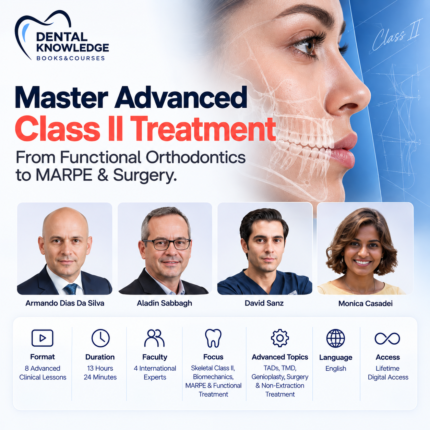
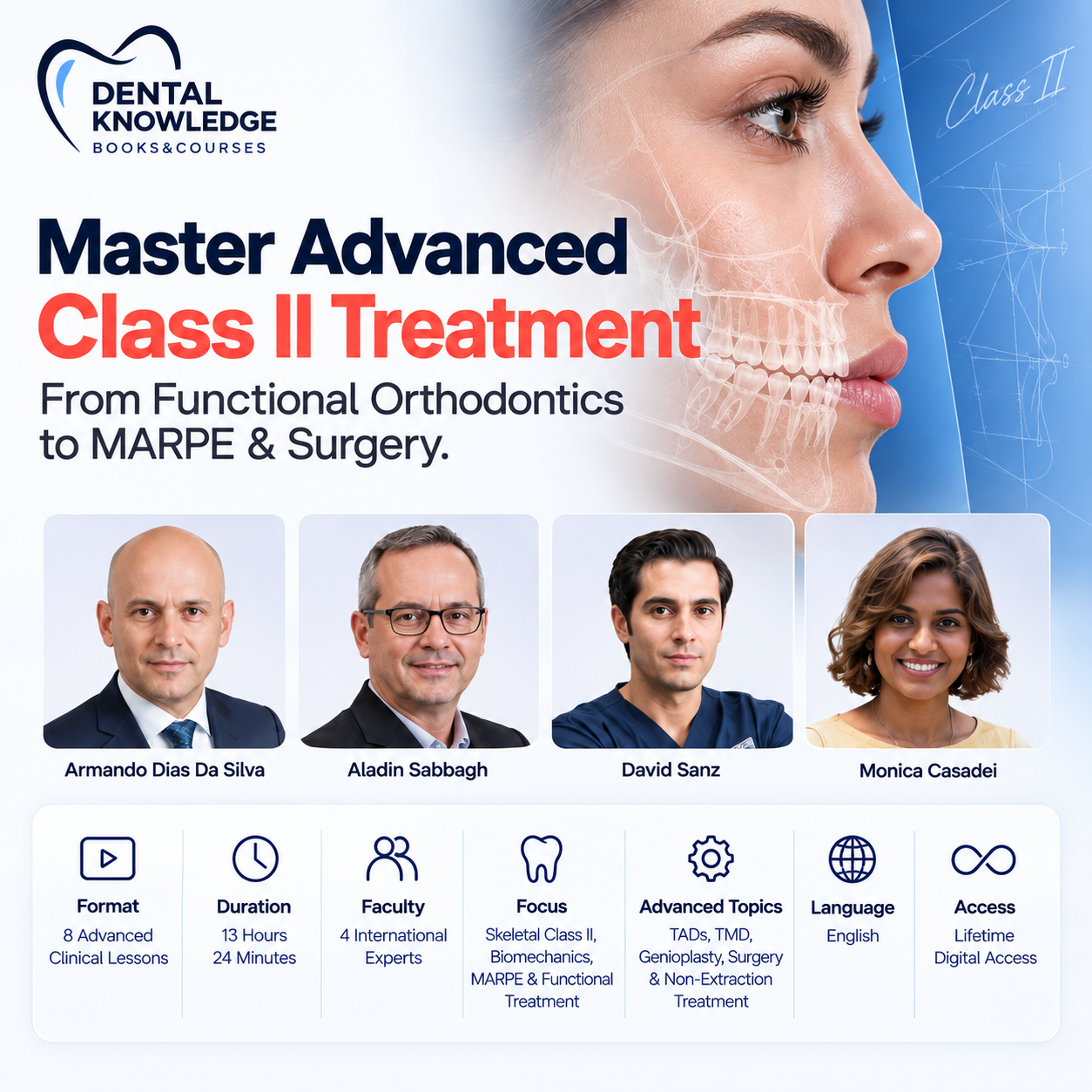
Master Advanced Class II Treatment — From Functional Orthodontics to MARPE & Surgery.
An advanced orthodontic masterclass focused on the diagnosis and treatment of skeletal Class II malocclusions using modern non-surgical, surgical and interdisciplinary protocols.
Learn how leading clinicians approach skeletal discrepancies, vertical control, MARPE, TADs, progressive bite jumping, fixed functional appliances, genioplasty and complex adult Class II cases.
Format: 8 Advanced Clinical Lessons
Duration: 13 Hours 24 Minutes
Faculty: 4 International Experts
Focus: Skeletal Class II, Biomechanics, MARPE & Functional Treatment
Advanced Topics: TADs, TMD, Genioplasty, Surgery & Non-Extraction Treatment
Language: English
Access: Lifetime Digital Access
Recommended for: Orthodontists and General Dentists seeking advanced protocols for complex Class II treatment.
Advanced Class II Orthodontics: Diagnosis, Biomechanics & Modern Treatment Strategies
How do you choose between functional treatment, extraction, MARPE, skeletal anchorage and surgery in a complex Class II patient?
This intensive advanced program brings together 13 hours and 24 minutes of clinical orthodontic education focused on the diagnosis and management of skeletal Class II malocclusions and complex dentofacial discrepancies.
Across 8 comprehensive lessons, four international clinicians demonstrate different treatment philosophies — from detailed functional diagnosis and occlusal reconstruction to MARPE, TAD-assisted mechanics, progressive bite jumping, genioplasty and combined orthodontic-surgical treatment.
What You Will Learn
- Advanced diagnosis of skeletal Class II malocclusions
- Documentation and functional examination protocols
- Evaluation of the stomatognathic system
- Vertical dimension and occlusal plane control
- Dentoalveolar, vertical and articular compensation
- High-angle and low-angle Class II treatment
- Class II open-bite management
- Early treatment of skeletal Class II
- Management of dysfunctional Class II patients
- Role of genioplasty in facial harmonization
- Conventional vs. self-ligating orthodontic systems
- Passive and interactive ligation concepts
- CCO biomechanics and torque expression
- Extraction and non-extraction treatment strategies
- MARPE protocols for transverse deficiency
- Digital orthodontic workflows
- Progressive mandibular advancement
- Fixed functional Class II appliances
- TAD-assisted Class II treatment
- TMD considerations during orthodontic treatment
- Class II treatment in adolescent and adult patients
- Management of Class II asymmetries
- Relapse prevention and retention
Complete Course Program
Lessons 1–2 – Different Treatment Approaches for Skeletal Class II
Lecturer: Monica Casadei | Total Duration: 3h 29min
Build a comprehensive diagnostic framework for skeletal Class II patients before selecting the appropriate orthodontic strategy.
Functional & Diagnostic Assessment
- Medical and dental anamnesis
- Muscle and joint palpation
- BruxChecker assessment
- Articulator mounting protocols
- Anatomic and individualized face-bow records
- Condylographic examination in selected cases
Stomatognathic & Occlusal Analysis
- Sagittal condylar inclination
- Occlusal plane inclination
- Fronto-canine control
- Vertical dimension management
- Posterior discrepancy
Clinical Class II Cases
- High-angle skeletal Class II
- Low-angle skeletal Class II
- Skeletal Class II with open bite
- Dysfunctional Class II cases
- Early Class II treatment
Lessons 3–4 – Genioplasty & Facial Aesthetics in Class II
Lecturer: David Sanz | Total Duration: 2h 39min
Explore the relationship between skeletal Class II correction, chin projection and overall facial balance.
- Facial analysis in Class II patients
- Recognition of chin hypoplasia
- Orthodontic vs. orthodontic-surgical correction
- Aesthetic indications for genioplasty
- Role of chin surgery in facial harmonization
- Integration of orthodontics and maxillofacial surgery
Lessons 5–6 – Orthodontic Systems, Extraction, Surgery & MARPE
Lecturer: Armando Dias Da Silva
Compare different orthodontic systems and learn how treatment mechanics change according to skeletal, transverse and dentoalveolar requirements.
- Evolution from conventional orthodontic mechanics
- Passive self-ligation concepts
- Interactive ligation
- Introduction to the CCO System
- Binding, notching and friction
- Torque expression
- Rotational control
- Arch-form selection
- Step-by-step crowding cases
- Vertical discrepancy management
- Extraction protocols
- Surgical vs. non-surgical treatment
- MARPE for transverse maxillary deficiency
- Digital orthodontic planning concepts
Lessons 7–8 – Progressive Bite Jumping & Non-Compliance Class II Treatment
Lecturer: Aladin Sabbagh
A comprehensive approach to Class II correction using fixed functional appliances, progressive mandibular advancement and skeletal anchorage.
Progressive Bite Jumping
- Principles of functional mandibular advancement
- Stepwise mandibular advancement
- Functional condylar repositioning
- Indications and limitations
- Dentoalveolar and skeletal effects
- Insertion and activation protocols
- Retention and troubleshooting
Non-Compliance & Non-Extraction Treatment
- Management of patients with limited cooperation
- Adolescent Class II with limited residual growth
- Moderate adult non-surgical Class II treatment
- Unilateral Class II asymmetry
- Aplasia and missing molars
- Combining fixed Class II appliances with TADs
- Strategies to avoid extractions and headgear in selected cases
TMD, Airways & Functional Diagnosis
- Relationship between malocclusion, TMD and airway disorders
- Manual functional analysis
- Condyle positioning considerations
- Class II treatment in selected sleep-apnea cases
- Reducing the risk of iatrogenic TMD
- CBCT and MRI indications
- Axiography and EMG considerations
- Manual therapy and physiotherapy in complex cases
Retention & Long-Term Stability
- Retention concepts following functional Class II correction
- SARA-Splint concepts
- Relapse prevention
- Troubleshooting difficult cases
Four Experts – Multiple Treatment Philosophies
One of the major strengths of this program is its multidisciplinary approach. Instead of presenting a single orthodontic technique, the course compares different diagnostic and therapeutic strategies.
- Monica Casadei – Skeletal Class II diagnosis, functional analysis and occlusal concepts
- David Sanz – Maxillofacial surgery, genioplasty and facial aesthetics
- Armando Dias Da Silva – Orthodontic biomechanics, MARPE and advanced appliance systems
- Aladin Sabbagh – Progressive bite jumping, fixed functional appliances, TMD and non-compliance treatment
Key Clinical Topics
Skeletal Class II • MARPE • TADs • Progressive Bite Jumping • Fixed Functional Appliances • Genioplasty • TMD • Occlusal Plane Control • Vertical Control • Open Bite • Self-Ligation • Extraction vs. Non-Extraction • Orthognathic Surgery • Adult Orthodontics • Functional Diagnosis
Course Details
Format: 8 Advanced Video Lessons
Total Duration: 13 Hours 24 Minutes
Faculty: 4 International Experts
Language: English
Specialty: Orthodontics
Level: Advanced
Primary Focus: Skeletal Class II Diagnosis & Treatment
Access: Lifetime Digital Access
Who Is This Course For?
This program is designed for orthodontists and general dentists who want to expand their ability to diagnose and manage complex skeletal and dentoalveolar Class II cases.
It is especially valuable for clinicians interested in adult orthodontics, functional appliances, MARPE, TAD-assisted mechanics, TMD-aware orthodontics and interdisciplinary orthodontic-surgical treatment.
Go Beyond Standard Class II Mechanics
Class II treatment is not a single protocol. Patient age, growth pattern, vertical dimension, transverse deficiency, facial aesthetics, TMJ condition and compliance can completely change the treatment strategy.
This masterclass gives you a broader clinical framework for choosing between functional correction, skeletal expansion, extraction, non-extraction mechanics, TADs and surgical approaches according to the individual patient.
How can I access the course after purchase?
Immediately after checkout, we email you a secure link to all materials. If you don't see the message, please check your spam or junk folder.
If you completed the order while logged in to your account, you'll also find the download links anytime in your Dashboard → Downloads section.
What payment methods are accepted for purchasing the course?
We accept a variety of payment methods, including credit cards, debit cards, and PayPal, to make your purchase convenient and secure.
How long do I have access to the course material?
Upon purchasing any of our courses, you will enjoy unlimited access to the course material. This means you can watch and revisit the videos and other resources whenever you wish, allowing for a thorough and comprehensive learning experience.
Is the course accessible on mobile devices?
Yes, our courses are designed to be accessible on both desktop and mobile devices. You can easily access the course content using a web browser on your smartphone or tablet, providing flexibility in your learning.
Is there any certification provided after completing the course?
While our courses are highly educational and designed to enhance your knowledge and skills, they do not include formal certifications. However, the valuable expertise you gain from our courses can significantly benefit your surgical practice and patient outcomes.
What is the format of the course?
All our courses are delivered in a video series format. The content is available for high-definition download, ensuring the best learning experience for you.
Do I need any special software to access the course videos?
No special software is required to access the course videos. You can conveniently download the videos online using any standard web browser on your computer or mobile device.
Can I download the course materials for offline access?
Absolutely! You will have the option to download all course materials, including lecture slides, handouts, and supplementary resources. This allows you to access the content offline whenever and wherever it suits you best.